Are you a morning person? Or do you do better at night? Finding out what your chronotype is can be a game changer for your productivity and your overall life. Knowing when it’s the best time for the different activities in your life will help you organize better and work around your own clock. As they say, timing is everything.
Think about it, how many times did you miss a good opportunity because of bad timing? Or you didn’t perform at your best because your schedule didn’t allow you to use your time better? Timing, chronotypes, and how to make them work for you. Let’s talk about them in this blog post.
“Time isn’t the main thing. It’s the only thing”. – Miles Davis

Some Basics On Chronotypes
In his book “When”, Daniel H. Pink talks about the importance of timing for every activity and event in your life. And he cannot be more right about it.
The three chronotypes he describes are larks, owls, and third birds.
- Larks are the usual morning people, the “early birds”, who get out of bed early even without an alarm, probably around 6 a.m.
- Owls are at their best at night, and won’t get out of bed before 10 a.m. if they don’t have to get up earlier to work or study.
- Third birds are the third category, something in between both extremes. And the majority of people fall into this category. They are naturally inclined to wake up between 8 and 10 a.m.
Mood and performance oscillate throughout the day. This is why it is so crucial to know your chronotype. Most people are either early birds or third birds, and the world is based around them. Work and school typically start in the early morning and people are supposed to go to bed relatively early.
If you are a night owl, this won’t work so well for you, so you’ll need to have a strategy in place to make the most of your routines.
Another important part of chronotypes is knowing that everyone experiences three phases of productivity over the course of a day, and these are: peak, trough, and rebound.
For most people, the trough happens after lunch. The peak will be in the early morning for larks and third birds, and late afternoon/evening for owls. The rebound will be the opposite; afternoon/evening for larks and third birds, and morning for owls.
These three parts are key to combine with your chronotype to make the most of your time.
What Can You Do About Your Chronotype
Okay, so what can you do about it? First, if you don’t know which one is your chronotype, you can take this free online test.
You can also do a time audit to see how you are currently using your time and get a better idea of when you complete your best work and when you are less productive. All this information will help you determine your chronotype alongside the test and also find the best strategy to make the most of it.
Once you know if you are a lark, owl, or third bird, the next step is to define what type of activity you need to perform, because as you can see, based on your chronotype, different times will suit you the best.
Most activities you do fall into one of these categories:
- Analytical tasks: which demand high focus, and hypervigilance. Some examples: learning new information, analyzing documents, solving problems, strategic meetings, and making important decisions.
- Insight tasks: involve creative work that requires wider focus, imagination, and good mood. Some examples: writing, brainstorming solutions, having new ideas, and meetings that involve building relationships and accountability.
- Administrative tasks: involve busy work that doesn’t need a lot of brain power. Some examples: processing emails, returning phone calls, making appointments, scheduling meetings, tidying up, or organizing files.
You can use this chart to try and match your best times to the activities you need to perform:
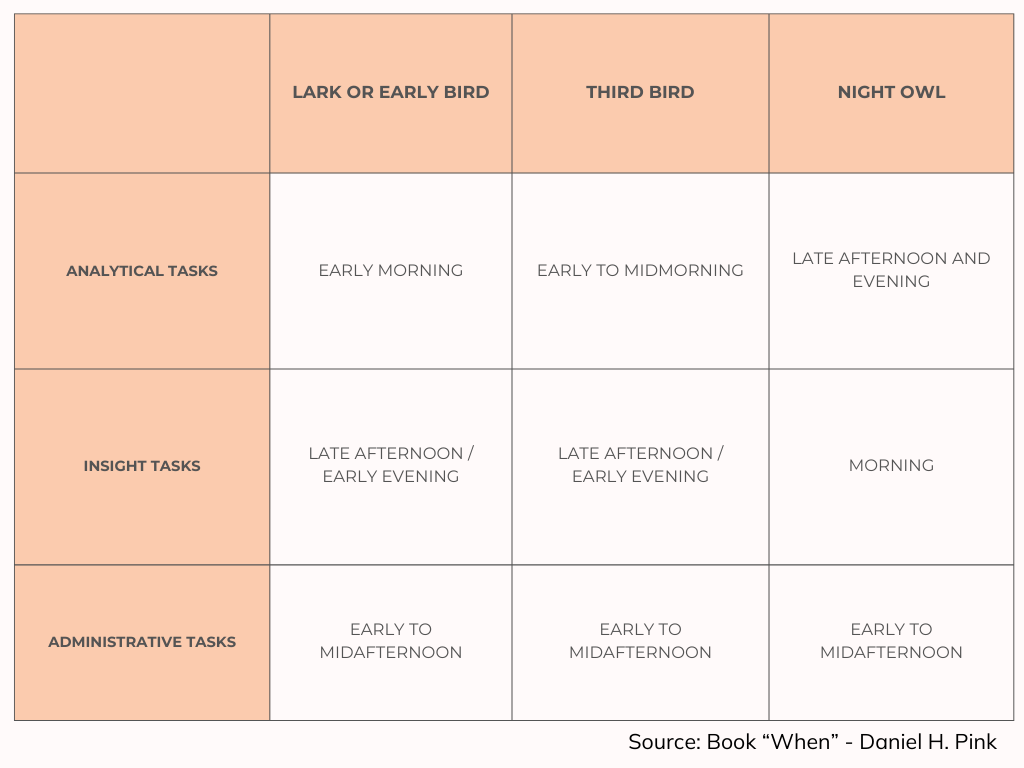
In general, when you are at your peak and right before it, try to do your most demanding tasks, and use your trough time -early afternoon for all types- to do administrative or repetitive tasks.
What If You Cannot Control Your Schedule
If you don’t have control over your schedule, because you have a fixed working schedule or you have certain obligations you need to attend at specific times, try these tips:
- Be aware of your reality and work the margins: The first thing you need to do is to be aware of your fixed schedules so you can make the most of that time and also the available free time you have to allocate your resources in the best way possible according to your chronotype.
- Determine your priorities and make them non-negotiables: If you only have one or two hours in your day to work on your priorities, you better know what those are so you can focus on them and use your time in the best way possible. Aim for a maximum of three top priorities per day.
- Use your peak hours wisely: Avoid distractions and put the necessary boundaries to make the most of your peak hours. A couple of hours of undistracted work is way better than eight hours of unfocused work.
- Use time-blocking techniques: Both for analytical and administrative tasks, use the time-blocking technique that adapts best to your purpose. For focused work, the Pomodoro Technique can help you balance work and breaks for a better outcome.
- Take better breaks: This is especially important when you are in your less productive time of the day. If you take a break, you will automatically feel refreshed and you can refocus.
Using Your Chronotype To Improve Other Aspects Of Your Life
Knowing your chronotype can help you not only to be more productive at your job, but it can improve different areas of your life, like your sleep, and your eating habits.
Let’s go through additional tips in which you can use your chronotype in your favor:
Optimize your sleep schedule
The best sleep schedule for each chronotype will be:
- Early bird or lark wake-up time is around 6 a.m. and sleep time is around 9 or 10 p.m.
- Third bird wake-up time is around 7 or 8 a.m. and sleep is around 11 p.m.
- Night owl wake-up time is around 9 or 10 a.m. and sleep time is after midnight.
The quality of your sleep is as important as the time you go to bed and wake up. Keeping a regular sleep schedule will be your ally if you are trying to optimize your sleep schedule. You can also try out these suggestions for a better night’s sleep.
Eat at the right times
One thing applies to all chronotypes, you should give your body enough time to digest before sleep, which means trying to eat your last meal between 2 and 3 hours before bed. Also, please focus on the quality of your diet and drinking enough water.
The best eating schedule for each chronotype will be:
- Early birds or larks: breakfast around 7 a.m.; lunch around noon and dinner around 6 p.m.
- Third birds: breakfast around 8 a.m.; lunch around 1 p.m. and dinner around 7 or 8 p.m.
- Night owls: breakfast around 10 a.m.; lunch around 2 p.m. and dinner around 9 p.m.
Remember that these are simply suggestions, you can work around them and fit them into your schedule.
Have solid morning and evening routines
No matter your chronotype, having a morning routine to help you start your day on the right foot can do wonders for you. If you are a night owl you may want to make this shorter, but pick some activity you enjoy doing that can help you boost your mood as soon as you wake up.
The same goes for evening routines, having a routine that makes you unwind and disconnect from your day will help you sleep better and wake up refreshed the next morning. The timing may change, but larks, third birds, and owls will benefit from having these routines.
“I used to believe that timing was everything. Now I believe that everything is timing.” – Daniel H. Pink
Finally, embrace your chronotype. Instead of trying to change your natural rhythm or using a schedule that does not make you feel good, work the margins and make small changes toward your chronotype. You will be able to make the most of your time and enjoy yourself in the process. Let’s do it!
Pin it!